 English
 Español
 Português
 русский
 Français
 日本語
日本語 Deutsch
 tiếng Việt
 Italiano
 Nederlands
 ภาษาไทย
 Polski
 한국어
한국어 Svenska
 magyar
 Malay
Malay বাংলা ভাষার
 Dansk
Dansk Suomi
Suomi हिन्दी

808nm Diode Laser: The Gold Standard of Aesthetic Hair Removal Amid Industry Upgrades
808nm Diode Laser: The Gold Standard of Aesthetic Hair Removal Amid Industry Upgrades
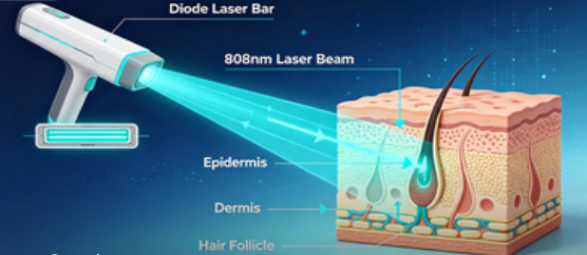
The 808nm diode laser continues to maintain its position as the preferred solution for professional permanent hair removal across global medical aesthetics markets, while the industry undergoes clear structural shifts toward lightweight portable units, multi-wavelength integration and intelligent system upgrades, according to the latest market observations.
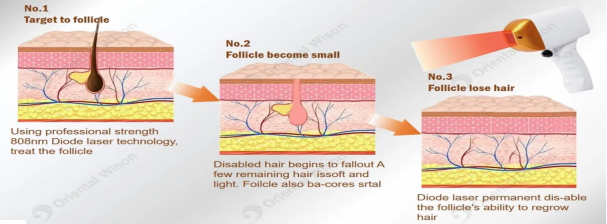
Recognized as the optimal wavelength for selective photothermolysis, 808nm strikes a balanced absorption ratio to melanin within hair follicles. It delivers stable treatment effects for most skin and hair types with lower risks of epidermal burns, outperforming traditional IPL equipment and cementing its decades-long reputation as the industry benchmark.
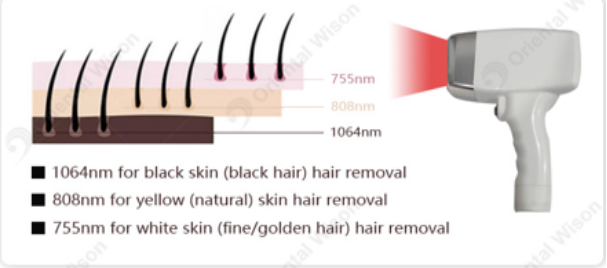
Industry insiders point out two major visible trends reshaping market competition in 2026. First, demand for portable air-cooled 808 diode laser devices rises rapidly. Compared with traditional bulky water-cooled floor-standing models, compact 3–5kg portable machines cut logistics costs, suit chain beauty salons, mobile aesthetic practitioners and small clinics, and gradually become mainstream choices for new buyers, especially in emerging markets in Southeast Asia, Australia and Latin America.Second, single-wavelength equipment faces increasing competition from combined platforms integrating 755nm+808nm+1064nm triple wavelengths. Multi-wavelength handpieces expand adaptability covering light fine hair and dark skin tones, helping clinics improve equipment utilization and customer coverage. Meanwhile, AI-powered skin analysis, intelligent parameter presetting and optimized sapphire contact cooling systems have become standard upgrades on new-generation devices to enhance treatment comfort and standardize operation.
As supply chain maturity improves, Chinese manufacturers are strengthening global influence. With complete ISO13485 production systems, CE and FDA-compliant product lines, local suppliers provide flexible OEM & ODM services, occupying a growing share of mid-to-high-end global aesthetic laser exports.Challenges remain for market participants. Distributors and clinic operators face pressure from tight capital budgets in many regions, alongside intensified low-end homogenized price competition. Manufacturers are shifting strategies from pure price competition to long-term value: extending diode bar service life, optimizing after-sales maintenance schemes and offering customized training support for overseas partners.
Moving forward, analysts forecast steady growth of the 808 diode laser segment through 2030. Future innovation will focus on higher electro-optic conversion efficiency, quieter continuous operation, and the expansion of VCSEL-based 808 technology into premium home-use devices, forming differentiated markets between professional clinic equipment and consumer home appliances.
Send Inquiry



X
We use cookies to offer you a better browsing experience, analyze site traffic and personalize content. By using this site, you agree to our use of cookies.
Privacy Policy

 Whatsapp:8613811714803